
Choosing the right explainer video length is not just a creative decision. It affects how clearly you can explain your offer, how much detail you can include, and how well the video fits its intended use.
For most B2B teams, the real question is not simply “how long should the video be?” The better question is, what does the buyer need to understand before they are ready to take the next step?
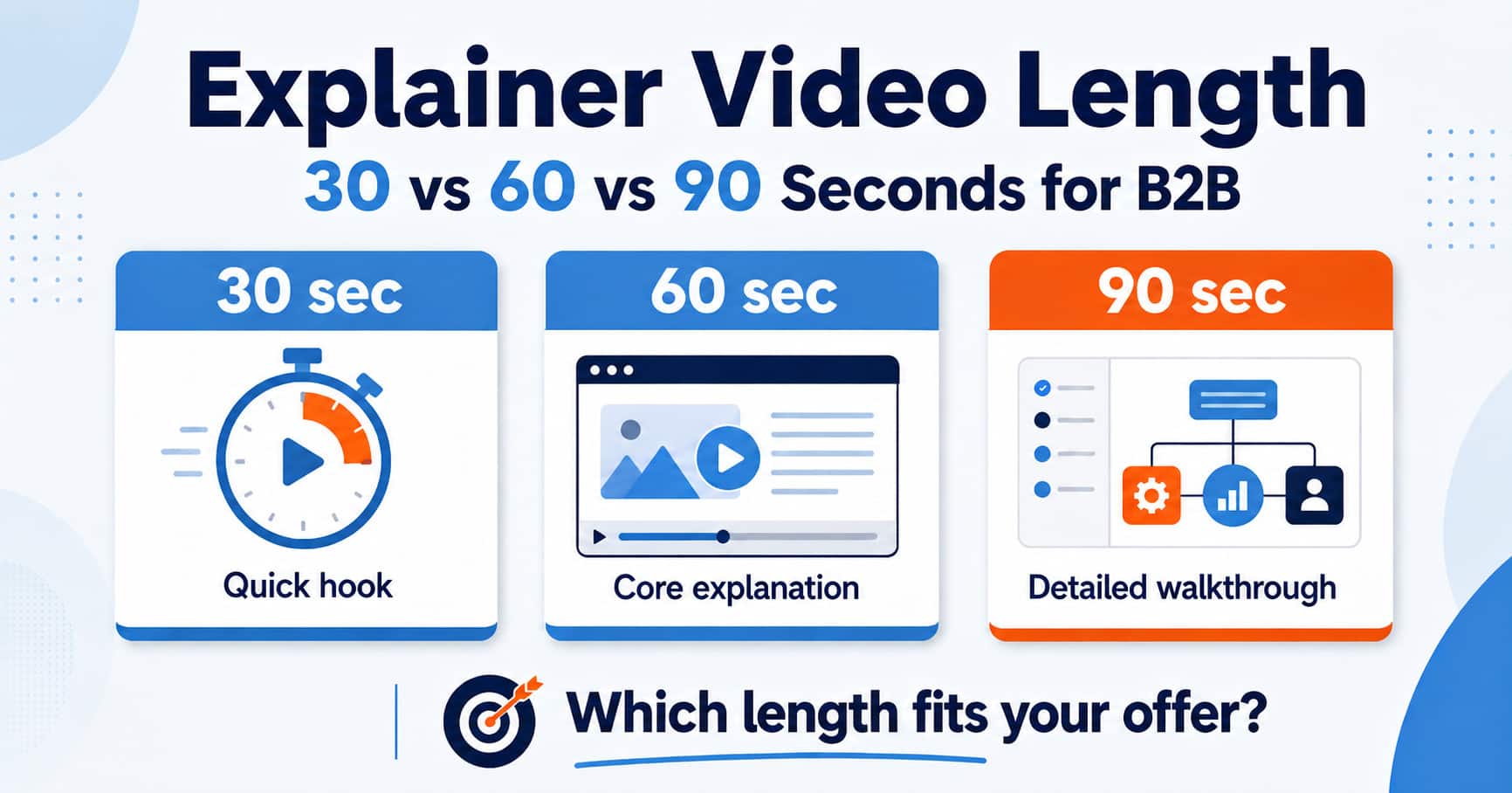
A 30-second video can work well for a simple message or outreach campaign. A 60-second video is often a practical fit for homepage and product-page explanations. A 90-second video gives more room for complex offers, multi-step workflows, or sales enablement content.
Why Explainer Video Length Matters
B2B buyers rarely have unlimited attention. They are usually comparing several options, scanning pages quickly, and trying to understand whether a product or service deserves more time. A video that is too short may leave important questions unanswered. A video that is too long may lose the viewer before the main point becomes clear.
The right video duration depends on four practical factors: offer complexity, audience awareness, page context, and the next action you want the viewer to take. A cold prospect seeing your brand for the first time needs a different video than a warm buyer reviewing options after a sales call.
This is why video length should be decided after the message is clear. Start with the buying situation, then choose the runtime that gives the message enough room without adding unnecessary detail.
Quick Comparison: 30 vs 60 vs 90 Second Explainer Videos
Use this quick comparison to choose the video length that best matches your message, buyer awareness, and production scope.
30 Seconds
Best for:
Simple offers, quick hooks, cold outreach, short landing page teasers.
Not ideal for:
Complex products, multi-step services, detailed demos.
Approx. script length:
About 75 words.
Best channels:
LinkedIn ads, email follow-up, social posts, simple landing pages.
Pricing impact:
Lowest scope.
60 Seconds
Best for:
Most B2B homepage explainers, product or service overviews, and sales page videos.
Not ideal for:
Very technical products or multiple buyer personas.
Approx. script length:
About 150 words.
Best channels:
Homepage, pricing page, product page, and sales follow-up.
Pricing impact:
Balanced scope.
90 Seconds
Best for:
Complex B2B offers, SaaS workflows, onboarding, multi-step processes, and sales enablement.
Not ideal for:
Simple offers that can be explained quickly.
Approx. script length:
About 225 words.
Best channels:
Sales enablement, onboarding, post-call follow-up, and detailed landing pages.
Pricing impact:
Higher scope.
When a 30-Second Explainer Video Makes Sense
A 30-second video is best when the message is simple and the viewer does not need much context. It works well as a short introduction, a teaser for a landing page, or a follow-up asset in outreach. Because the format is short, it forces the script to focus on one clear point.
This length is a good fit when you need to explain a single pain point, introduce one main benefit, and invite the viewer to take a small next step. It is not the right format for explaining a complex SaaS workflow, a multi-step service, or a product with several buyer objections.
A 30-second format can also work well for a whiteboard explainer video package when the goal is a simple product, service, or process explanation.
When a 60-Second Explainer Video Makes Sense
For many B2B teams, 60 seconds is the most practical starting point. It gives enough room to introduce the problem, explain the offer, show how the solution works, and close with a clear next step. This is why the one-minute format is commonly used for homepage videos, product pages, and sales pages.
A 60-second video usually allows for a more complete message without becoming too heavy. It can explain the core problem, the value proposition, and two or three key points. For a buyer who is already on your site, that is often enough to decide whether to keep reading, compare packages, or contact your team.
If you are comparing production scope and package options, it helps to review animated explainer video pricing and match the length to the amount of detail your offer truly needs.
When a 90-Second Explainer Video Makes Sense
A 90-second explainer video gives more room for complex offers. It can be useful when the buyer needs to understand several steps, multiple stakeholders are involved, or the product is difficult to explain with a short headline and a few bullet points.
This length is often better for SaaS products, technical services, onboarding flows, or sales enablement content. It can help explain how a workflow changes, why the problem matters, and how the solution fits into the buyer’s current process.
The trade-off is cost and attention. A 90-second video requires more script development, visual planning, animation, and review time than a shorter video. It should earn that extra length by answering questions that shorter formats cannot answer clearly.
For more polished or complex visual storytelling, a premium explainer video package may be a better fit than trying to compress too much information into a shorter format.
How to Choose the Right Length for Your Offer
A simple way to choose the right runtime is to look at the buyer’s current level of understanding. If the buyer already understands the problem and only needs a quick reason to care, 30 seconds may be enough. If the buyer needs a clear overview of the problem, offer, and outcome, 60 seconds is usually more useful. If the buyer needs context, process explanation, or stakeholder reassurance, 90 seconds may be justified.
You should also consider where the video will appear. A video used in cold outreach has to earn attention quickly. A video embedded on a pricing or product page can take more time because the visitor has already shown intent. A video shared after a sales call can go deeper because the viewer is already engaged.
If you want to see how different styles and formats work in practice, you can view explainer video examples before choosing a final length.
How Length Affects Pricing and Production Scope
Video length affects pricing because every additional 30 seconds usually requires more script writing, storyboarding, voiceover time, animation work, revisions, and production review. A longer video is not just a longer export. It is more messaging, more scenes, and more decisions.
At Wyse Sales Videos, package pricing starts at $698 per 30 seconds for whiteboard videos, $1,198 per 30 seconds for animated explainer videos, and $1,998 per 30 seconds for premium videos. The final project scope depends on style, duration, visual complexity, and what needs to be included.
A practical way to manage cost is to choose the shortest length that still explains the offer clearly. You can compare video packages if you want to see how different formats and durations affect the project scope.
Common Mistakes When Choosing Video Length
Trying to explain everything in one video. An explainer video should clarify the next step. It does not need to replace a product demo, sales deck, onboarding course, or technical documentation.
Choosing a length before the message is clear. If the script has no clear focus, even a 90-second video will feel confusing. Start with the main buyer question, then choose the length.
Using 30 seconds for a complex offer. Short videos work best for simple messages. If your buyer needs to understand a process, workflow, or several decision factors, the message may need more room.
Using 90 seconds when 60 would be enough. Longer is not automatically better. If the offer is easy to understand, extra runtime can dilute the message.
Ending without a clear next step. The viewer should know what to do after watching: compare packages, view examples, contact the company, book a call, or continue reading.
When an Animated Explainer Video Is Not the Best Fit
Animated explainers are strong when the product, service, process, or offer is hard to explain with static text alone. They are especially useful for abstract ideas, invisible workflows, complex services, and situations where buyers need a quick overview before taking the next step.
They are not always the best choice for every situation. If your buyer needs a click-by-click software walkthrough, a screen-recorded product demo may be better. If you sell a simple physical product that is easy to understand from photos and specs, animation may not add enough value. If the offer itself is unclear, the message should be fixed before production starts.
This is why the right question is not only “how long should the video be?” It is also “what should the video help the buyer understand?”
Practical Recommendation for Most B2B Teams
For most B2B homepage and product-page use cases, start by planning around 60 seconds. It gives enough room to explain the core problem, introduce the offer, and guide the viewer toward the next step.
Use 30 seconds when the message is simple, the audience is cold, or the video is designed for outreach and quick attention. Use 90 seconds when the offer is complex, the buying committee needs more context, or the video will support sales enablement and onboarding.
The best length is the one that gives the buyer enough clarity without asking for unnecessary attention. That balance is more important than following a fixed rule.
Next Step
If you are not sure which length fits your offer, start with the message first. A simple offer may only need 30 seconds. Most B2B homepage videos fit well around 60 seconds. More complex products, services, or workflows may need 90 seconds to explain clearly.
You can compare Wyse Sales Videos packages, view portfolio examples, or contact us if you want help choosing the right format before starting a project.

0 Comments